What Does 5050 Mean for LED Lights?
February 26, 2026
Read:5
Source: Ledestar
What Does 5050 Mean for LED Lights?
In the LED industry, the term “5050” is commonly understood as a size reference. Technically, it describes a surface-mount LED package measuring 5.0 mm × 5.0 mm. However, in professional outdoor lighting applications, 5050 represents far more than its footprint. It defines a high-power structural platform designed for multi-chip integration, enhanced thermal performance, and long-term environmental reliability.
For street lighting, flood lighting, high mast systems, and other outdoor luminaires, understanding what 5050 truly means requires analyzing its material system, internal chip architecture, thermal pathway, and system-level implications.
Ledestar High Lumen LED 5050
| Product | Model | Current | Voltage | LPW | Substrate |
|---|---|---|---|---|---|
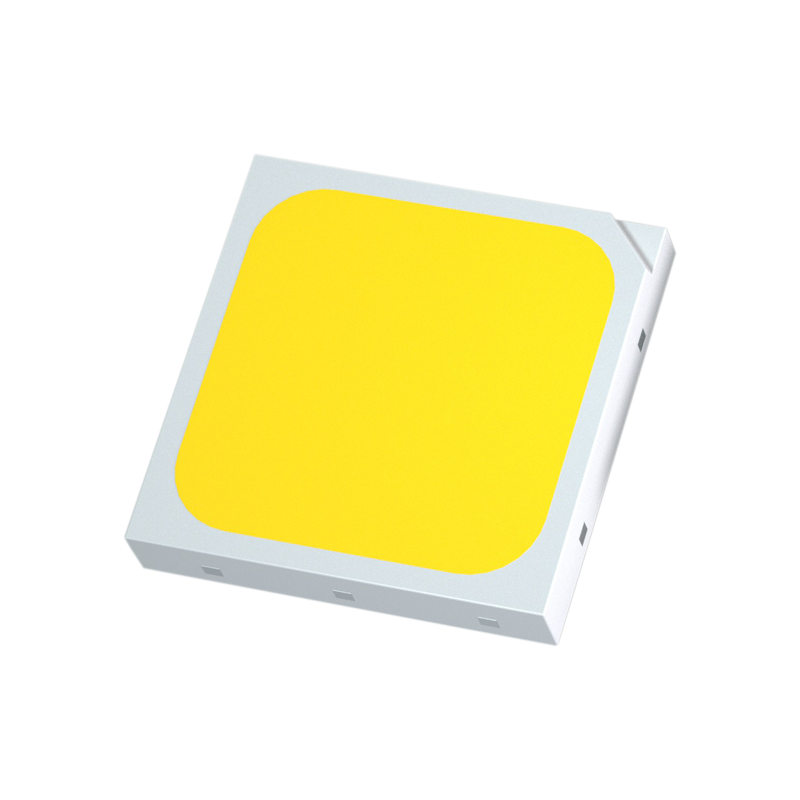 | 506F | 150mA | 6V | 270lm/W | EMC |
 | 510T | 150mA | 6V | 258lm/W | EMC |
What Does 5050 Refer to in LED Packaging?
The naming convention follows standard SMD LED dimensions, with “5050” indicating a 5.0 mm by 5.0 mm package. Compared with smaller formats such as 2835 or 3030, the 5050 provides significantly more internal space. This larger structural platform allows for a wider thermal pad, stronger bracket materials, and greater flexibility in chip layout.
In outdoor lighting, where power density and durability are critical, this additional structural volume becomes a technical advantage rather than just a physical measurement.
EMC and PCT Brackets: The Structural Core of 5050 LEDs
In high-power outdoor lighting, the bracket material of a 5050 LED is one of the most important reliability factors. The two mainstream materials are EMC (Epoxy Molding Compound) and PCT.
EMC 5050 Structure
EMC-based 5050 LEDs are widely used in demanding outdoor environments. EMC offers high heat resistance, strong UV stability, low moisture absorption, and excellent sulfur resistance. These characteristics are essential for streetlights and infrastructure lighting that operate continuously in high ambient temperatures and polluted urban environments.
Because EMC maintains reflectivity and structural stability over long operating periods, it significantly reduces risks of discoloration, cracking, or lumen depreciation caused by material aging. For projects targeting 50,000–100,000 hours of service life, EMC-based 5050 LEDs provide a robust long-term solution.
PCT 5050 Structure
PCT is another commonly used material in 5050 brackets, especially in cost-optimized outdoor luminaires. It offers good thermal resistance and mechanical strength while maintaining competitive manufacturing cost. In many commercial floodlight and municipal applications, PCT-based 5050 LEDs achieve a practical balance between reliability and budget.
Choosing between EMC and PCT is not simply a material preference; it directly affects thermal endurance, environmental resistance, and lifetime performance in outdoor systems.
Multi-Chip Integration: Modern 5050 for High Lumen Output
Historically, 5050 LEDs were associated with RGB configurations because they could accommodate three chips. However, modern 5050 technology has evolved far beyond decorative applications.
Today’s high-power 5050 LEDs can integrate 6, 8, 10, or even more LED dies within a single package. This multi-die architecture transforms the 5050 into a compact high-lumen engine suitable for demanding outdoor lighting systems.
By distributing electrical load across multiple chips, the package achieves high luminous flux while maintaining controlled junction temperatures. Instead of overdriving a single die, which accelerates thermal stress and lumen depreciation, the multi-chip structure spreads heat more evenly. This improves lumen maintenance and long-term reliability.
In practical terms, a high-power multi-die 5050 LED can deliver hundreds to well over one thousand lumens per package, depending on configuration and drive conditions. For 150W–300W streetlights or high-power floodlights, this reduces the total number of LEDs required, simplifying PCB layout and improving overall system robustness.
Thermal Management and Outdoor Reliability
Outdoor luminaires operate under harsh conditions: high summer temperatures, winter cold cycles, humidity, pollution, and long daily operating hours. Thermal management therefore becomes the defining factor in LED lifetime.
The 5050 package supports a relatively large bottom thermal pad, allowing efficient heat transfer to aluminum MCPCB boards. When properly mounted and driven within optimal current ranges, this design helps maintain lower junction temperatures, which directly correlates with better lumen maintenance (L70/L90) and reduced color shift over time.
High-quality 5050 LEDs used in outdoor lighting typically operate in the 3W to 10W+ range per package, with luminous efficacy reaching 200–250 lm/W depending on binning and color temperature. For roadway lighting, Ra70 or Ra80 is commonly selected to balance efficiency and visibility performance. Warm white options such as 2200K–3000K are increasingly specified in dark-sky-compliant projects, while 4000K–5000K remains common for highways and industrial zones.
Why 5050 Is Strong in the Outdoor Lighting Market
The outdoor lighting market demands high lumen density, structural stability, and long operational lifetime. The 5050 platform addresses these requirements by combining material robustness with multi-die flexibility.
Compared with smaller packages like 2835, the 5050 handles higher current and reduces LED quantity per module. Compared with 3030, it offers more internal volume for complex chip integration and ultra-high lumen designs. In medium-to-high wattage luminaires, this structural advantage can simplify optical alignment and reduce system-level risk.
Because of its square geometry and centralized emitting surface, the 5050 also integrates efficiently with secondary optics used in roadway and floodlight lenses. Whether designing Type II or Type III street distributions, asymmetric beams, or high-intensity flood optics, the 5050 provides consistent light output and strong optical compatibility.
Conclusion: 5050 as a High-Power Outdoor Platform
While “5050” technically describes a 5.0 mm × 5.0 mm SMD LED package, in modern outdoor lighting it represents a high-power structural platform built for durability and performance. With EMC or PCT bracket options and the ability to integrate up to 10 chips or more, the 5050 LED has evolved into a high-lumen solution for demanding environments.
For manufacturers designing streetlights, floodlights, and industrial outdoor systems, selecting a properly engineered 5050 LED is not simply a component choice. It is a strategic decision that affects thermal behavior, optical efficiency, lifetime performance, and overall project reliability.
In the outdoor lighting market, where infrastructure investment and maintenance cycles matter, the 5050 LED remains one of the most versatile and powerful package platforms available today.
Table of Contents